


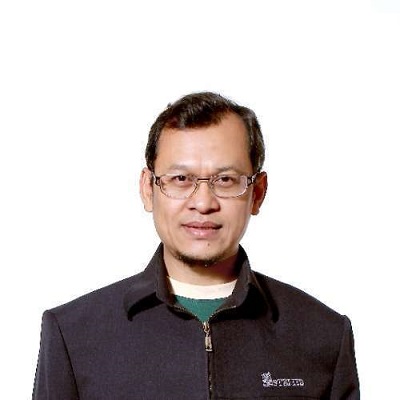
Bio:
Andriyan Suksmono received a Bachelor degree in Physics and Master degree in Electrical Engineering from the Institut Teknologi Bandung (ITB), Indonesia and a Ph.D. degree in Engineering from The University of Tokyo, Japan in 1990, 1996, and 2002 respectively. Prior to joining ITB, he worked as a Systems Programmer in a private bank. From 1996 to 2005, he was with ITB as an Instructor; from 2005 to 2009 as an Associate Professor; and since 2009, he has been a Professor of the School of Electrical Engineering and Informatics (SEEI), ITB. His primary research interests are Quantum Computing, Signal Processing, and Imaging. He was a recipient of several international research funds, grants, scholarships, and fellowships; among others, from RCAST-Tokyo University, Monbukagakusho, JSPS, AIGRP, Asahi Glass, the Hitachi Foundation, and IBM Quantum. In 2004, he received the APNNA Best Paper Award for Theoretical Development; presented by the APNNA (Asia Pacific Neural Network Assembly), Indian Statistical Institute, and Jadavpur University, for his work on spatiotemporal ultra-wideband neuro-beamforming. He was also a recipient of the Outstanding Faculty Award (Dosen Berprestasi) of ITB, in June 2007; the Outstanding Faculty Award of the Republic of Indonesia (1st place), in August 2007; the ITB Innovation Award, in 2017; the ITB Research Award, in 2020; The 114-, 115-, and 116- Most Prospective Indonesia Innovation Awards of 2022, 2023, and 2024, respectively. He was a member of IBM Quantum for Researchers program and received an IBM Quantum Credit Grant of Quantum Computer usage time (which is equivalent to around USD 50,400).
Dr. Suksmono has been working on quantum algorithms for finding Hadamard matrices (QHSA-Quantum Hadamard matrix Search Algorithm) since 2017, whose results are published in a series of papers. They are recognized as the most downloaded paper in Scientific Reports (Nature Portfolio), i.e, The Top 100 in Physics 2020 (QHSA-1, the 8-th place), Top 100 in Physics 2023 (QHSA-2, the 2-nd place), Editor’s Choice (2023) and is listed in the Quantum Algorithm Zoo. The QHSA-3 was published in September 2025 and now he is working on QHSA-4.
He serves as a member of the Editorial Board in Scientific Reports (Nature Portfolio), IJEEI, and IJEHMC. He was a PI in the Center of Research Collaboration in Quantum Technology 2.0, Indonesia and The Head of the Quantum Technology Laboratory, SEEI-ITB. He is a Senior Member of the IEEE, Professional Member of the ACM and the Chair of Bandung ACM Chapter.
Available Lectures
To request a single lecture/event, click on the desired lecture and complete the Request Lecture Form.
-
Finding Hadamard Matrices Using Quantum Computers
Quantum computing — harnessing the superposition, tunneling, and entanglement principles — offers capabilities of problem solving beyond the classical Turing-Machine mode. This...
-
Quantum Technology: The Second Quantum Revolution
This presentation explores the Second Quantum Revolution and its impact on computing, communication, and sensing. After reviewing the evolution of information technology and the limitations of...
-
Understanding Compressive Sensing
Compressed Sensing or Compressive Sampling (CS) is a new paradigm in modern signal processing and sensing. Rooted in the uncertainty principle—CS provides a powerful framework for...
To request a tour with this speaker, please complete this online form.
If you are not requesting a tour, click on the desired lecture and complete the Request this Lecture form.
All requests will be sent to ACM headquarters for review.